
Module IV
Coding and Development
About this module
Welcome to Introduction to Coding and Development, a comprehensive course designed to provide you with a strong foundation in the world of programming and software development. Whether you're
Learning outcomes
By the end of this course, you will be able to:
- Understand Fundamental Concepts: Gain a deep comprehension of core programming concepts, including variables, data types, loops, and conditionals, forming the building blocks of coding
- Write Code: Develop the ability to write and debug simple programs in popular programming languages, such as Python or JavaScript, and apply coding best practices
- Problem-Solving Skills: Acquire problem-solving skills and techniques used by developers to break down complex problems into manageable steps and develop efficient solutions
- Version Control: Learn the fundamentals of version control systems (e.g., Git) to track changes, collaborate with others, and manage your code projects effectively
- Web Development Basics: Explore the basics of web development, including HTML and CSS, to create and style web pages, laying the groundwork for further exploration into front-end and back-end development
How you'll learn
During the lesson you must read the written explanations and follow the given instructions at interactive elements. To achieve the designated learning outcomes we support you by providing essential content for the learning process, such as tutorial videos and interactive tests.
AI Programming Languages and Tools
AI programming is at the forefront of technological innovation, enabling machines to perform tasks that traditionally required human intelligence. To work effectively in the field of AI, it's essential to understand the programming languages and tools that power these intelligent systems. Here, we'll explore some of the key languages and tools used in AI development:
First, let’s go into programming languages. Here are quite a lot of them, but we’ll mention several of the most popular ones. Look for this:
To reach the presentation, press Ctrl and click the image.
If you’re still struggling to choose proper language for AI coding, this video might help you:
Which Programming Language for AI? | Machine Learning
Now it’s time to learn something about the most important tools used in AI coding:
- TensorFlow Why TensorFlow? TensorFlow is an open-source machine learning framework developed by Google.
It offers a high-level API (Keras) and low-level operations for building and training neural networks.
TensorFlow is known for its scalability and support for both CPUs and GPUs.
- PyTorch:
Why PyTorch? PyTorch is a deep learning framework that emphasizes flexibility and dynamic computation graphs. It has gained popularity among researchers and developers for its ease of use and extensive community support.
- scikit-learn:
Why scikit-learn? Scikit-learn is a Python library for traditional machine learning algorithms. It provides a user-friendly interface for tasks like classification, regression, clustering, and dimensionality reduction.
- Jupyter Notebooks:
Why Jupyter? Jupyter Notebooks are interactive, web-based environments that facilitate AI development by allowing you to combine code, documentation, and visualizations in a single platform. They are widely used for prototyping and experimenting with AI models.
- Apache Spark:
Why Apache Spark? Apache Spark is a powerful open-source framework for distributed data processing, which is essential for handling large datasets in AI applications. It offers libraries like MLlib for scalable machine learning.
- IBM Watson, Microsoft Azure AI, and Google AI Platform:
Why these AI Platforms? These cloud-based AI platforms provide a suite of tools and services for developing, training, and deploying AI models. They offer pre-built AI models, data management, and scalability for AI projects.
Understanding these AI programming tools is crucial for anyone looking to enter the field of artificial intelligence. Whether you're interested in machine learning, natural language processing, computer vision, or other AI domains, mastering these languages and tools will open doors to exciting AI-driven possibilities. In this course, we will explore how to leverage these resources to build intelligent applications and solutions.
To learn about some more useful AI programming tools, see this video:
5 Best AI Coding Assistant Tools in 2023
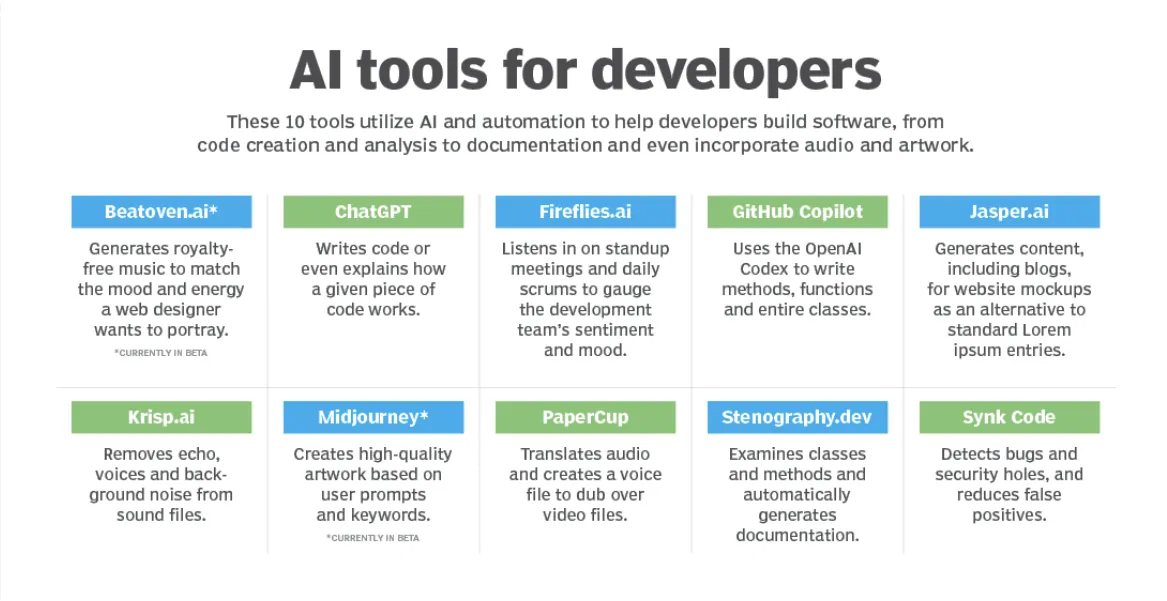
This infographics points out some more useful AI tools for programmers:
Source of this image and link to the article:
elopers Short introduction of the next block:
In the Block 2 you will learn about Coding Best Practices.
Coding and Development – Coding Best Practices
Welcome to “Coding Best Practices”, the second chapter of our module. Here, we delve into the principles that distinguish skilled coders, regardless of your experience level. Coding is more than just functionality; it's about crafting code that's readable, modular, and reliable.
In this block, we explore key concepts such as code readability, documentation, modular design, and version control. Well-structured code saves time, reduces errors, and enhances future adaptability.
Whether you're an aspiring developer or a seasoned pro, join us on this journey to unlock the secrets of writing code that not only gets the job done but also showcases your coding expertise. Let's get started!
Want to learn how to develop code efficiently? Here you are. These are the most essential points about best coding practices:
- Readability: Write clear and understandable code with meaningful names and a consistent style.
- Documentation: Add comments and document your code to explain its purpose and usage.
- Modular Design: Break code into smaller, reusable functions or classes for manageability.
- Version Control: Use Git for tracking changes and collaboration, and write informative commit messages.
- Testing and Debugging: Create unit tests, debug systematically, and profile for optimization.
- Avoid Duplication: Eliminate code repetition by using functions, classes, or libraries.
- Error Handling: Implement proper error handling, including user-friendly error messages.
- Keep Learning: Stay updated, embrace simplicity, and engage in code reviews for continuous improvement.
Also, reading this article should be beneficial. It describes different ways of using AI in software development. Also, it may help you understand programming terminology and learn proper coding practices. The link is below:
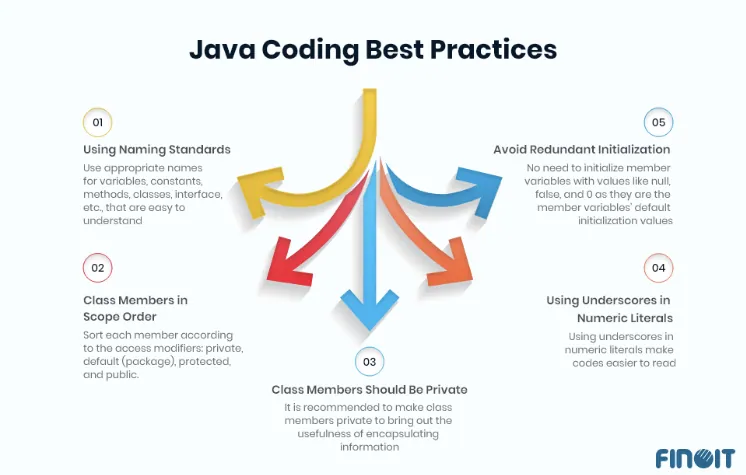
Here is the example of Java coding best practices:
Source of the image (and link to the article):
Do you feel it is difficult to focus on coding or it takes you so much time? Then this video is for you:
How to Learn to Code FAST (Do This or Keep Struggling)
Now it is the time for a quiz! Measure your knowledge by solving this short test:
To access the quiz, press Ctrl and click the image.
- Best Practices for Python Main Functions
- Code Review Best Practices
- The right way to organise your code
- 5 Best Coding Practices Main take-aways:
- Code Quality: Participants will grasp the significance of code quality and how it impacts software development processes and outcomes.
- Collaboration: Learners will appreciate the collaborative nature of coding best practices,
End of module
Module complete
Continue when you're ready.